


Are you aware that RSA and ECC encryption algorithms, which protect a company's core assets, are actually on a countdown to obsolescence? Facing the algorithm replacement deadline of 2030,Post-quantum cybersecurityNo longer a laboratory theory, but a strategic core that will determine a company's survival for the next decade. Facing the quantum threat of "intercept now, decrypt later," simple superficial fixes are no longer sufficient; what we need is a forward-looking, in-depth architectural transformation.
We understand the anxiety of technical decision-makers regarding system downtime or incompatibility, and we recognize the challenge of inventorying hidden cryptographic assets. This article will precisely deconstruct the technical essence of PQC and the latest NIST standards, and share how to achieve automated inventory through tools like Wave-Key. You will receive a clear and actionable migration blueprint, starting from building "crypto-agility," to lead your enterprise through a generational evolution in the quantum era, transforming unknown challenges into robust competitive advantages.
Key points:
- Master the latest NIST 2026 standards (such as ML-KEM and ML-DSA) and understand the quantum threats faced by traditional RSA and ECC algorithms.
- Establish a "crypto-agility" strategic mindset to ensure enterprise systems can flexibly replace core cryptographic architectures without interrupting operations.
- In-depth analysisPost-quantum cybersecurityA transformation roadmap, from crypto asset inventory to system migration, setting executable phased goals.
- Leverage automation tools like Wave-Key and Wave-On to precisely identify hidden encryption risks and significantly lower the development barrier for software migration.
Table of Contents
-
The Quantum Threat of 2026: Why Traditional Encryption Will No Longer Be Enough to Protect Your Data
-
NIST PQC Standards Implementation: Core Algorithms and Technical Architecture Analysis
-
Starting with Cryptocurrency Inventories: Building Corporate "Crypto-Agility"
-
PQC Transition Blueprint for Key Industries: Finance, Cloud, and Government Agencies
The Quantum Threat of 2026: Why Traditional Encryption Will No Longer Be Enough to Protect Your Data
We are at a major turning point in cybersecurity history. For a long time, the trust foundation of the global digital economy has been built on asymmetric encryption algorithms such as RSA and ECC. These algorithms utilize the mathematical challenges of large prime factorization and discrete logarithms, making them nearly unbreakable on traditional computing architectures. However, with the rapid evolution of quantum computer hardware, these once impenetrable defenses are facing collapse. Today, in 2026, the quantum threat is no longer a distant prediction but an existential crisis that businesses must confront immediately.
What concerns cybersecurity experts most isn't future quantum computers, but the current "Harvest Now, Decrypt Later" (SNDL) attack model. Attackers are mass stealing and storing encrypted sensitive data, waiting for quantum computing power to mature before decrypting it. This means that if your company has not yet implementedPost-quantum cybersecurityEven if data is encrypted now, its value may become worthless years later. The focus of cybersecurity defense has shifted from "is it secure now" to "long-term security throughout the data's lifecycle."
The Impact of Quantum Supremacy on Critical Enterprise Data
Not all data faces the same risks, but data with long-term value is the most dangerous. Medical records, financial credentials, patented technologies, and state secrets are data that typically requires confidentiality for ten years or more. If encryption systems fail, companies will face immeasurable legal liabilities and damage to their reputation. To counter this threat,Post-quantum cryptography(PQC, Post-Quantum Cryptography) emerged. Simply put, PQC refers to a new generation of cryptographic technologies that can run on existing traditional computer and network architectures but whose mathematical logic is sufficient to resist attacks from quantum algorithms. This is an upgrade of mathematical challenges, aiming to ensure that data remains inviolable even in the quantum era.
The technical leap from traditional encryption to post-quantum encryption
Facing quantum threats, simply increasing key length is not a long-term solution. While symmetric encryption (like AES-256) can maintain a certain level of security by increasing bit length, asymmetric encryption (RSA/ECC) faces systemic destruction from Shor's algorithm. Simple reinforcements cannot bridge the technological gap; what businesses need is a deep architectural evolution.
-
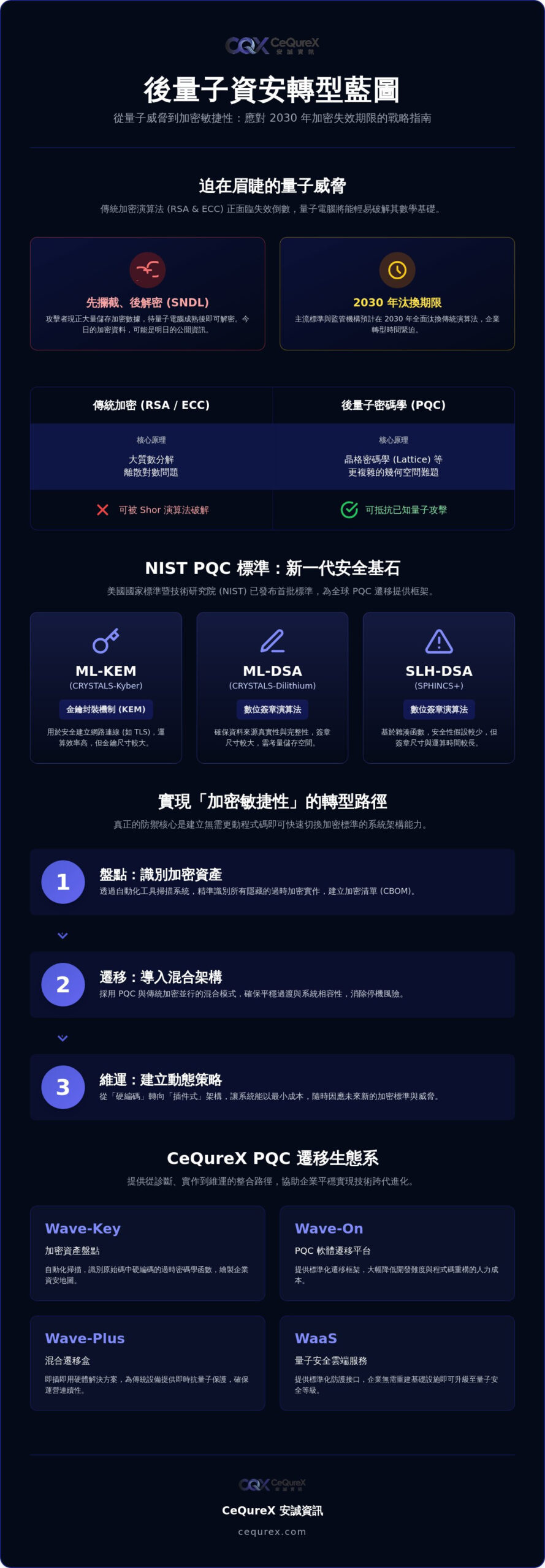
Core principle differences: Traditional encryption relies on number theory problems, while PQC shifts to more complex geometric space problems like lattice-based cryptography.
-
Performance and Compatibility PQC algorithms typically come with larger key sizes and computational overhead, which poses challenges for existing hardware architectures.
-
Standardization process: NIST officially released standards FIPS 203, 204, and 205 in 2024. In 2026, governments and financial regulatory bodies began requiring companies to present clear transition timelines.
The current cybersecurity environment is undergoing a critical transition from experimental stages to standardization.Post-quantum cybersecurityImplementation is no longer an option, but a rigid requirement for compliance. 2030 will be the deadline for the full replacement of existing algorithms, leaving businesses with little time for system inventory and migration. Building crypto-agility will be the only path for businesses to remain competitive under the quantum threat in the future.
NIST PQC Standards Implementation: Core Algorithms and Technical Architecture Analysis
In August 2024, the U.S. National Institute of Standards and Technology (NIST) officially released the first three post-quantum cryptography standards: FIPS 203 (ML-KEM), FIPS 204 (ML-DSA), and FIPS 205 (SLH-DSA). This marks a globalPost-quantum cybersecurityFrom theoretical research, it has officially entered the large-scale implementation phase. When building defense systems, enterprises must understand the underlying logic of these algorithms to achieve a strategic balance between performance and security.
Currently, most mainstream PQC algorithms are based on Lattice-based Cryptography. Compared to the prime factorization that traditional RSA relies on, the complexity of finding the shortest vector in multi-dimensional spaces in lattice problems is extremely high, making it difficult even for quantum computers to crack effectively. According to NIST PQC Standards With the proliferation of standardized algorithms and the growing need for enhanced security, lattice-based cryptography has emerged as the preferred path for industries upgrading their encryption architectures due to its excellent balance between key size and computational speed.
Characteristics Analysis of Mainstream PQC Algorithms
ML-KEM (formerly Kyber) is primarily used as a key encapsulation mechanism, particularly suitable for establishing secure connections in network protocols like TLS 1.3. It boasts extremely high computational efficiency, but this comes at the cost of significantly increased key sizes. For instance, the public key for ML-KEM-768 is approximately 1,184 bytes, substantially larger than traditional ECC. This necessitates network architectures capable of handling larger packets to avoid latency during the handshake phase.
ML-DSA (formerly Dilithium) is responsible for digital signatures, ensuring data authenticity and integrity. During implementation, ML-DSA's signature size is relatively large, which is a technical hurdle that cannot be ignored for embedded systems or IoT devices with limited storage space. When implementing, businesses should prioritize considering the system's throughput and processing power to ensure that the upgrade does not affect the user experience.
System compatibility considerations when implementing PQC
At this stage, the most practical deployment method is to adopt a hybrid encryption mode. This architecture uses traditional ECC or RSA in parallel with PQC algorithms. Even if unexpected vulnerabilities emerge in the early implementation of post-quantum algorithms, the traditional encryption layer can still defend against existing classical attacks. This dual protection mechanism is key for enterprises to smoothly transition to the quantum-safe era. To accurately assess whether existing systems have upgrade potential, companies can Wave-Key Encrypted Asset Inventory Service, identify which links in the system most need to prioritize the introduction of a hybrid encryption architecture.
For resource-constrained environments, such as industrial control systems, enterprises must pay special attention to processor cycles and memory usage. A key implementation recommendation is to avoid attempting to replace all algorithms at once; instead, build a software-defined architecture with cryptographic agility. This will allow enterprises to replace algorithms with minimal cost when new NIST standards are released in the future, rather than starting from scratch. This flexibility will become a core competitive advantage for enterprises to maintain control in a constantly changing cybersecurity landscape.
Starting with Cryptocurrency Inventories: Building Corporate "Crypto-Agility"
With the quantum threat looming, companies that only focus on replacing algorithms will often find themselves in a passive predicament of "treating the symptom." The true core of defense lies in establishing crypto-agility. This is a system architecture capability that allows companies to quickly and seamlessly switch between different cryptographic algorithms and standards without altering core code. Facing rapid evolutionPost-quantum cybersecurityCompanies with agility can respond to new threats at any time, minimizing migration risks.
However, inventorying cryptographic assets is the biggest roadblock to this transformation. Many algorithms are hidden deep within legacy systems, or are encapsulated in third-party packages and complex cloud environments. Manual inventorying is not only time-consuming but also prone to omissions, creating critical security vulnerabilities. Companies are often unaware of how many outdated RSA or ECC implementations are running internally, which is the main reason for migration failures.
Define the cryptographic boundary of an enterprise.
Effective inventory must cover the entire path from the application layer and protocols to static data storage. Wave-Key, through automated scanning technology, can accurately identify hard-coded deprecated cryptographic functions in source code and transform these hidden assets into a visual encryption map. This not only allows security teams to see risks but also provides decision-makers with a transparent basis for transformation. Through this in-depth scanning, enterprises can clearly define which critical boundaries require immediate migration and which can be handled in phases.
Establish dynamic encryption policies
The ultimate goal of transformation is to move from a "hard-coded" to a "pluggable" cryptography architecture. Companies should begin by establishing a Cryptography Bill of Materials (CBOM), detailing every cryptographic implementation within their systems. This list should be synchronized with NIST Post-Quantum Cryptography standards Maintain dynamic alignment to ensure the defense system remains compliant with the latest global standards.
Establishing a CBOM is a strategic cornerstone for achieving long-term security. For a deeper understanding of how to accomplish this task through a systematic process, it is recommended to refer to Wave-Key Encrypted Asset Inventory implementation guide. By reducing human error with automation tools, businesses can navigate complexPost-quantum cybersecurityTransitioning, maintain a steady pace, ensuring every critical piece of data possesses quantum-resistant viability.
PQC Transition Blueprint for Key Industries: Finance, Cloud, and Government Agencies
Each industry's data lifecycle protection needs vary, which determines the priority of their migration to post-quantum architectures. By 2026, we observe leading companies are no longer waiting and watching, but rather developing tailored transformation roadmaps based on their business characteristics. From financial transactions requiring extremely high transmission speeds to government secrets demanding confidentiality for up to thirty years,Post-quantum cybersecurityThe adoption of [technology/solution] has become a key indicator of a company's digital resilience. This is not just a technological upgrade, but a strategic investment to ensure business continuity.
Financial industry's PQC migration priorities
Financial institutions face the most severe challenges. In addition to protecting customer privacy, the security of cross-border clearing systems (such as SWIFT) and blockchain assets is of paramount importance. When complying with the FSC's requirements for digital resilience, Taiwan's financial industry must accurately assess the impact of PQC algorithms on system performance. High-frequency trading environments are extremely sensitive to latency, and while algorithms like ML-KEM enhance security, they also increase computational load. The current strategic trend is to prioritize quantum-resistant upgrades for digital identity authentication and software signing, ensuring the authenticity of transaction instructions remains unshakable in the quantum era.
WaaS Deployment Models in a Hybrid Cloud Environment
For most companies, building a PQC environment from scratch is too costly. Cloud service providers are offering standardized protection interfaces to tenants through WaaS (Quantum-Safe Cloud Service). WaaS allows companies to upgrade to quantum-safe levels without rebuilding their infrastructure. This model significantly shortens the migration cycle, enabling development teams to focus on innovation at the application layer rather than on the implementation details of underlying cryptography.
In actual deployments, hybrid cloud architecture is currently the mainstream transition. The Wave-Plus Hybrid Migration Box demonstrates strong adaptability with its plug-and-play feature, allowing enterprises to enable post-quantum encryption channels simultaneously while maintaining their existing ECC algorithms. This parallel architecture effectively eliminates the risk of system downtime and ensures compatibility with third-party packages that have not yet been upgraded. If your enterprise is at a crossroads of architectural transformation, it is recommended to consult a professional team to plan the most robust migration path. Feel free to learn more. WaaS Quantum-Safe Cloud Service How can I assist you in simplifying complex upgrade processes?
Long-term Security Strategy for Defense and Supply Chains
Data handled by government and defense units often has long-term value. In the face of the "intercept now, decrypt later" threat, sensitive information transmitted today that lacks quantum resistance could be deciphered for decades to come. Therefore, establishing a quantum-resistant digital identity system has become the defensive boundary for supply chain security. This requires software developers to explicitly label cryptographic algorithms in Software Bill of Materials (SBOMs), ensuring that every layer of the supply chain possesses resilience against quantum attacks. ThroughPost-quantum cybersecurityThrough deep integration, both businesses and governments can maintain absolute control in the future digital battlefield.
CeQureX's PQC Migration Ecosystem: From Wave-Key to WaaS
In the transition to address quantum threats, businesses are often most concerned not with the technology itself, but with the high complexity and potential incompatibility risks during the migration process. CeQureX deeply understands this challenge, and therefore has built a completePost-quantum cybersecurityEcosystem. This system is not a collection of disjointed tools, but an integrated pathway from diagnosis and implementation to long-term maintenance. It aims to assist enterprises in achieving smooth technological generational evolution without overthrowing existing architectures.
The starting point of this transformation is Wave-Key Encrypted Asset InventoryIt acts as the creator of the enterprise cybersecurity map, identifying encryption risks deep within systems through automated scanning. Following that,Wave-On PQC Software Migration Platform This greatly reduces development difficulty, allowing the team to integrate next-generation algorithms into existing software in an automated manner. For scenarios requiring hardware-level protection,Wave-Plus Hybrid Transition Box Provides the perfect solution for the transition period, ensuring seamless interoperability between old and new systems under a hybrid encryption architecture.
Automation tools to lower the barrier to transformation
The core design of the Wave-On platform lies in simplifying processes. Traditional algorithm replacement requires significant human effort for code refactoring, whereas Wave-On, through a standardized migration framework, enables developers to quickly integrate NIST-compliant cryptographic logic, significantly shortening development cycles. Simultaneously, the Wave-Plus hybrid migration box addresses security gaps at the hardware level. It offers plug-and-play functionality within existing communication links, providing real-time post-quantum protection for legacy devices. This is a crucial strategic tool for maintaining operational continuity for financial and manufacturing sectors that possess a large number of older facilities. CeQureX is not just a technology provider, but a strategic partner leading enterprises across the technological divide.
Action Path: How Does Your Business Get Started?
Building quantum resilience is a marathon, not a sprint. We recommend that businesses plan their approach using the following milestones:
-
Previous 3 months: Perform a comprehensive inventory using Wave-Key to identify hidden encrypted assets and produce a CBOM list.
-
6th month: Initiate pilot migration of critical systems, introducing the Wave-On platform or Wave-Plus hybrid migration box.
-
12th month: Achieve global encryption agility and evaluate its implementation WaaS Quantum-Safe Cloud Service Achieve long-term flexible deployment.
Facing the impending collapse of traditional cryptographic systems, passive waiting is not a good strategy. Post-quantum cybersecurity is not an optional choice, but a mandatory course for the quantum era. Only by taking action now can enterprises maintain absolute control in the future digital battlefield. Contact us immediately. CeQureX Expert Team, unlock your crypto asset inventory, and build an impenetrable for your businessPost-quantum cybersecurityDefense line.
Seize the Crypto Initiative: Embark on Your Quantum-Safe Transformation Journey
The quantum threat is no longer a distant rumble of thunder, but an imminent architectural challenge. Establishing "crypto-agility" is not just about complying with NIST standards, but is key for businesses to maintain their core competitiveness in the quantum era. From Wave-Key's precise inventory to Wave-On's automated migration, each step strengthens the long-term vitality of systems, ensuring digital assets remain unbreakable for decades to come.
As a deep cultivatorPost-quantum cybersecurityAs a pioneer, CeQureX has leveraged its professional implementation experience to assist numerous financial and technological giants in achieving robust transformation strategies. Now is the optimal time to proactively identify risks and eliminate anxiety caused by the unknown. Don't let invisible crypto risks become stumbling blocks to your company's growth. Proactive action is the key to ensuring absolute control in the digital battlefield.
Book your CeQureX Crypto Asset Health Check now
Let us be your strategic partner in transforming complex technological disruptions into opportunities for generational enterprise evolution, navigating the quantum new era with confidence.
Common Questions About Post-Quantum Cybersecurity Transformation
What is the difference between Post-Quantum Cryptography (PQC) and Quantum Key Distribution (QKD)?
PQC is a new generation of cryptographic technology based on mathematical algorithms that can run directly on existing network and computer hardware. QKD, on the other hand, utilizes the physical properties of quantum mechanics for key distribution and requires the deployment of dedicated hardware equipment and fiber optic links. For most businesses, PQC offers extremely high deployment flexibility and cost-effectiveness, making it the mainstream strategic choice for addressing quantum threats.
When will NIST release the final PQC standards?
NIST officially released the first three PQC standards in August 2024, including FIPS 203 (ML-KEM), FIPS 204 (ML-DSA), and FIPS 205 (SLH-DSA). A draft standard for a fifth algorithm, HQC, is expected in early 2026. The official deadline of 2030 has been set for the deprecation of traditional algorithms such as RSA and ECC, and the standardization process has fully entered the implementation phase.
Is it too early for companies to start migrating to PQC now?
It's never too early to start migrating, primarily to counter the immediate threat of "intercept now, decrypt later" (SNDL). Attackers are currently stealing encrypted data in large quantities, waiting for future quantum computers to mature before they can crack it. Data with long-term value, such as medical records or national defense secrets, must be protected immediately.Post-quantum cybersecurityto ensure absolute security throughout the data lifecycle.
Will implementing PQC significantly degrade system performance?
PQC's key sizes and computational overhead are indeed higher than traditional encryption, but the impact on modern system performance is within controllable limits. With hardware acceleration technology and optimized algorithm implementations, most servers and mobile devices can operate smoothly. Enterprises can achieve the best balance between security and computational efficiency through hybrid encryption modes, ensuring user experience is not compromised.
What is crypto-agility, and why is it important for PQC migration?
Cryptographic agility refers to the ability of a system to quickly switch or update cryptographic algorithms without modifying the core code. BecausePost-quantum cybersecurityStill in the dynamic evolution stage, an agile architecture allows businesses to replace components at the lowest cost when future standards are updated or new vulnerabilities are discovered, avoiding the predicament of technical debt requiring a complete overhaul.
How does CeQureX's Wave-Key assist businesses with encryption inventory?
Wave-Key utilizes automated scanning technology to deeply analyze application source code, binary files, and third-party packages, identifying hidden cryptographic assets. It can visualize all running algorithms in the system and generate a detailed Cryptographic Bill of Materials (CBOM), assisting security teams in precisely understanding risk boundaries and establishing a clear navigation map for subsequent migration efforts.
Can traditional cryptography and post-quantum cryptography coexist?
They can coexist, which is referred to as a "hybrid migration architecture." The current best practice is to encapsulate traditional cryptography (like ECC) and PQC algorithms simultaneously within the same cryptographic channel. This approach ensures that during the transition period, even if the new algorithms have unexpected implementation vulnerabilities, the traditional cryptography layer can still provide a baseline defense, enabling a secure and smooth technological update.
Which industries should prioritize post-quantum cybersecurity transformation?
Financial services, government defense, healthcare, and critical infrastructure should be prioritized for transformation. These industries handle highly sensitive data with confidentiality requirements often extending beyond ten years. Faced with regulatory compliance pressures and the increasingly severe quantum threat, rapid adoption is crucial.Post-quantum cybersecurityIt is a necessary means to ensure long-term business continuity and legal compliance.